APPLICATIONS

Industrial applications of micro-perforation.

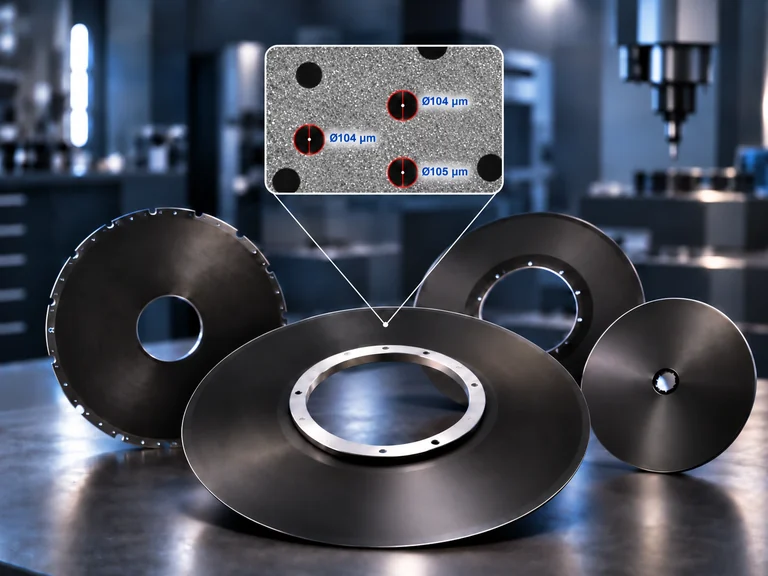
Precision laser micro-drilling and micro-perforation can be used for functions such as filtration, separation, controlled passage and flow distribution across metal surfaces. The appropriate solution is defined together with component geometry, material, operating conditions and system requirements.

Other functions of micro-perforation.

The role of a micro-perforated surface depends on the application. New components for the following functions can be evaluated project by project.

Other filtration & separation requirements

Micro-aperture geometry can be considered for applications requiring specific solids to be retained or separated from a process stream. Material, particle characteristics, open area and operating conditions are evaluated together.

Project-specific evaluation
Process stream + solids Other filtration & separation requirements — Micro-perforated surface Conceptual schematic showing a process stream passing through a micro-perforated surface while certain solids remain on its inlet side. Stream through the surface
Micro-perforated surfaceConceptual schematic · not to scale.

Controlled passage

Flow through a metal surface depends on more than individual aperture diameter. Hole density, pitch, open area, component thickness and aperture geometry together influence the passage characteristics.

Project-specific evaluation
Incoming flow Controlled passage — Defined apertures Cross-section schematic showing flow through defined apertures that follow the EMC web convention: narrower at the inlet and wider toward the outlet. Passage through apertures
Defined aperturesConceptual schematic · not to scale.

Flow distribution

The arrangement of apertures across a surface can be a design input where flow needs to spread over an area. The perforation pattern is evaluated together with the fluid, pressure conditions, open area and system geometry.

Project-specific evaluation
Incoming flow Flow distribution — Perforation pattern Conceptual schematic showing one incoming stream spreading across different regions of a perforated surface and passing through the apertures. Distribution across the surface
Perforation patternConceptual schematic · not to scale.

Working on a different component or application?

We do not define a new component by target aperture size alone. Its function, operating environment, material and existing system need to be defined together.

What should the component do?
Describe its role in the system and the requirement you want to address.
What conditions will it operate in?
Include the process medium, material, temperature, pressure, flow or flow rate and existing equipment details where available.
What reference do you have?
An existing component, technical drawing, sample or functional description can provide a starting point.

You do not need every technical detail to get started. We will clarify any additional information together after the first contact.

Let’s discuss your application.

Tell us your machine or system reference, process context or the requirement you want to address. If additional technical information, a drawing or sample is needed, we’ll clarify that in the next step.